
-
The impact of digital platforms on Myanmar’s media during the 2025–6 elections
The exile media has become increasingly reliant on digital platforms to inform the Myanmar public. Such reliance has exposed the media to regular attacks from the military, its allies, and the platforms themselves. This report surveys over 40 media outlets to uncover their experiences before, during, and after the 2026 elections. It was produced in partnership with IPCM and is also available in Myanmar language. Read >

Stay in the loop with everything you need to know about human rights in Myanmar.
-

Myanmar Submission on the safety of journalists for UN Resolution 59/15
The military has turned laws, courts, and digital infrastructure into tools to hunt journalists. This submission for UN Human Rights Council Resolution 59/15 documents mass detentions, lawfare, digital surveillance, gendered online violence and exile, and argues that protecting journalists now depends on independent civil-society frameworks rather than State mechanisms. Read >
-

Protecting women and children in Myanmar’s conflict
Women and children have been subjected to severe human rights violations since the coup in Myanmar. This report provides a formal submission to the UN High Commissioner for Human Rights regarding Resolution 60/19. It documents the targeting of women and children, advocating for comprehensive reparations, international accountability mechanisms, and the protection of fundamental human rights. Read >
-
Protecting Myanmar’s HRDs in the digital age
Myanmar’s human rights defenders are facing significant digital attacks in response to their work. This report was submitted to the UN Office for the High Commissioner for Human Rights, which is doing a global review of digital attacks. Read >


We focus on civil and political rights
- Digital rights
- Media freedom
- Freedom of assembly and association
- Liberty and fair trials
- Right to life
- …and more

-

How the military blocked independent media during the 2025-6 elections
This groundbreaking report uses big data to reveal how the military intensified internet blocking of independent media, social media platforms, and VPNs during the sham elections, aiming to prevent the public from accessing any independent reporting or communicating with each other. Read >
-

11 recommendations for proposed national human rights law
The proposed National Human Rights Law must prioritise international law and extend protection to all displaced and stateless persons. A conflict-sensitive mandate, judicial-grade independence for commissioners, and mandatory government responses to findings are essential. Without these structural reforms, the Commission risks failing Myanmar’s most marginalised populations in a contested environment. Read >
-

Military elections fail 5 key international standards
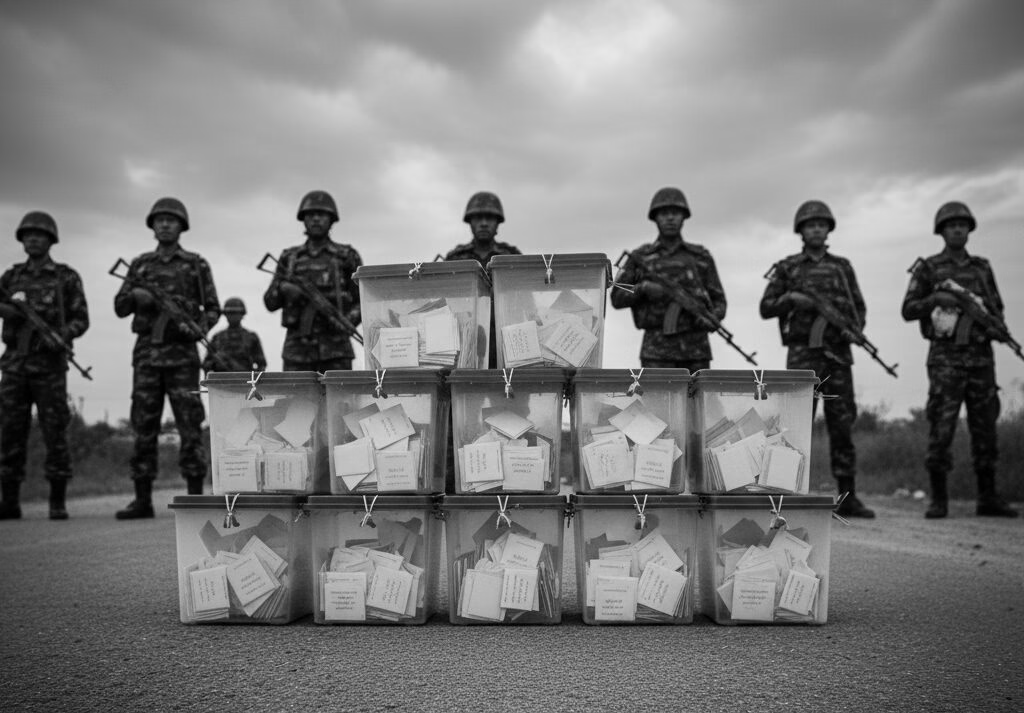
This report evaluates the 2026 Myanmar elections against international human rights law. The systematic audit across five legal pillars reveals a total collapse of international standards, characterised by State-sponsored coercion and structural disenfranchisement. This exercise was not a genuine election and the international community should make a principled rejection. Read >
Defending Human Rights in Myanmar
We are a civil society organisation researching, analysing, and advocating for change in Myanmar and internationally. More about us >
Defend Civil and Political Rights
Protecting freedom, equality, and democracy in Myanmar.
Advocate for justice
Championing legal reforms to ensure fairness and equal rights.
Monitor human rights
Tracking and reporting violations to hold perpetrators accountable.
Empower communities
Providing resources and support to strengthen human rights initiatives.
Expose abuses
Investigating and revealing injustices to the world through detailed reports.
Promote accountability
Pushing for consequences for those who violate human rights norms.
Previous work
-
Impact of digital surveillance on civic space in Myanmar
The military is weaponising surveillance to crush all civic space. AI-powered cameras and spyware are used to hunt journalists, human rights defenders, and political activists, while repressive new laws create a “rule by lawfare.” This digital dictatorship enables a high-tech war on women and criminalises the very act of seeking privacy. Read >
-
AI undermines cultural life in Myanmar
The military is weaponising Artificial Intelligence to dismantle cultural rights and undermine the right to development. By automating censorship, enforcing digital exclusion, and erasing minority identities, the military has created a digital dictatorship. This submission details how AI-driven repression violates international law and demands urgent global accountability. Read >
-
The effect of digital repression on transitional justice in Myanmar
Myanmar’s digital dictatorship creates significant barriers to transitional justice. While new technologies offer vital evidentiary tools, the military weaponises AI, biometric surveillance, and internet shutdowns to criminalise documentation and erase digital memory. This report to the UN calls for global evidence preservation protocols and digital restoration to protect the right to truth. Read >
-
Civil rights approach to accountability and transitional justice in Myanmar
Accountability is not only about punishing physical atrocities. It requires dismantling the structural machinery of oppression. This submission to the UN’s review explains that true justice in Myanmar involves restoring the rule of law and ensuring the protection of fundamental freedoms. Read >

-
Myanmar’s human rights challenges for 2026
International Human Rights Day offers an opportunity to examine fundamental rights in Myanmar and reflect on what may happen next year, in 2026. But before looking to 2026, Human Rights Myanmar’s previous predictions for 2025 are reviewed against reality. Read >

-
UN review of “terrorism” should recognise Myanmar’s experience of State terror
As the UN discusses the global definition of terrorism, Myanmar offers a crucial warning. Here, the State itself is the primary perpetrator of terror, yet it weaponises the law to label pro-democracy dissenters as “terrorists”. Our submission urges the UN to recognise this reality and prevent international laws from shielding State atrocities. Read >
-
NUG must ensure transparent, independent,and rights-respecting corruption inquiry
The investigation into allegations of misconduct and corruption within the Prime Minister’s Office offers a defining opportunity for the National Unity Government (NUG) to distinguish itself from the military regime. Read >

-
Myanmar freedom on the net 2025
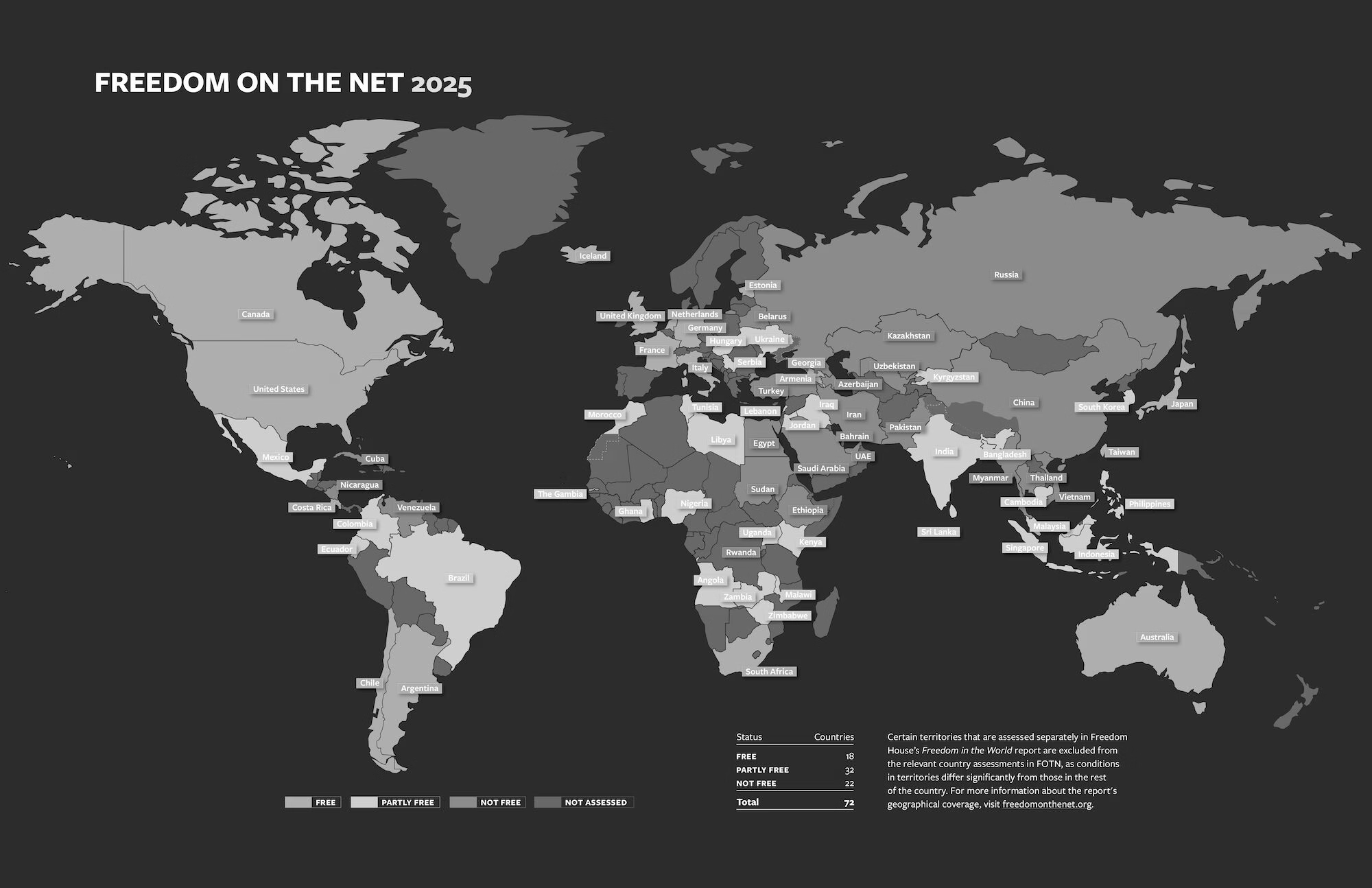
This year’s Freedom on the Net report finds that internet freedom in Myanmar remained one of the worst in the world, alongside China, with a score of 9 points out of 100. The military’s installation of advanced deep packet inspection technology and the resulting VPN block significantly worsened the situation, shifting the country from basic to advanced digital repression. Read >

-
Gender equality, the digital space and AI in Myanmar
The military is waging a high-tech war on women. Pro-military online groups dox women, publishing their private data and calling for their arrest. This “dox-to-arrest” pipeline is backed by an expanding network of AI-powered facial recognition cameras, which enables the military to track women. This systematic campaign violates women’s fundamental human rights to privacy, freedom of expression, and peaceful assembly. Read >
-
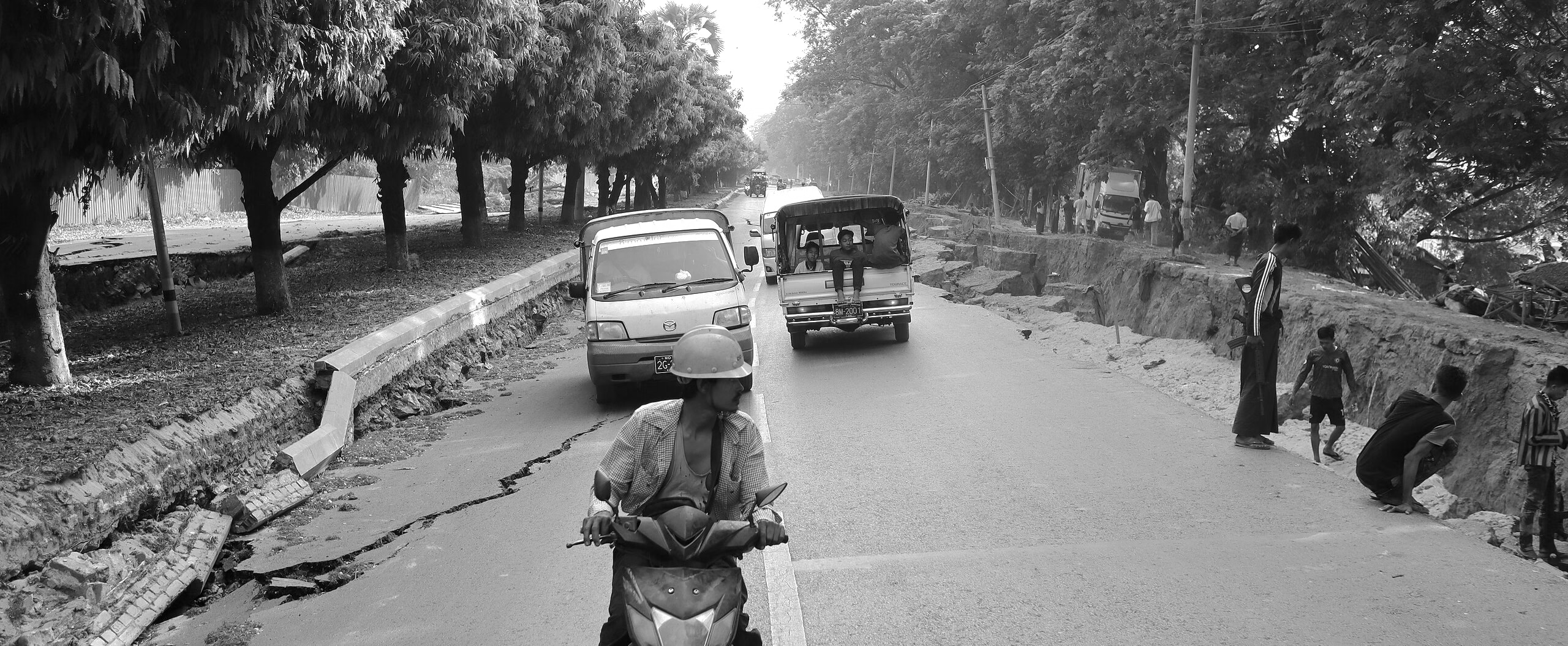
Civic aftershock: How restricting civil society obstructed Myanmar’s earthquake response
After six months of interviews and research, a new report explains how the military deliberately obstructed the 2025 earthquake response, exploiting the humanitarian crisis to suppress civic freedoms. ICNL’s comprehensive report, based on key informant interviews with earthquake respondents, details how the military weaponised laws, imposed a complex system of permissions, and blocked access to particular affected populations. The report finds this strategy was not a failure of capacity but… Read >

-
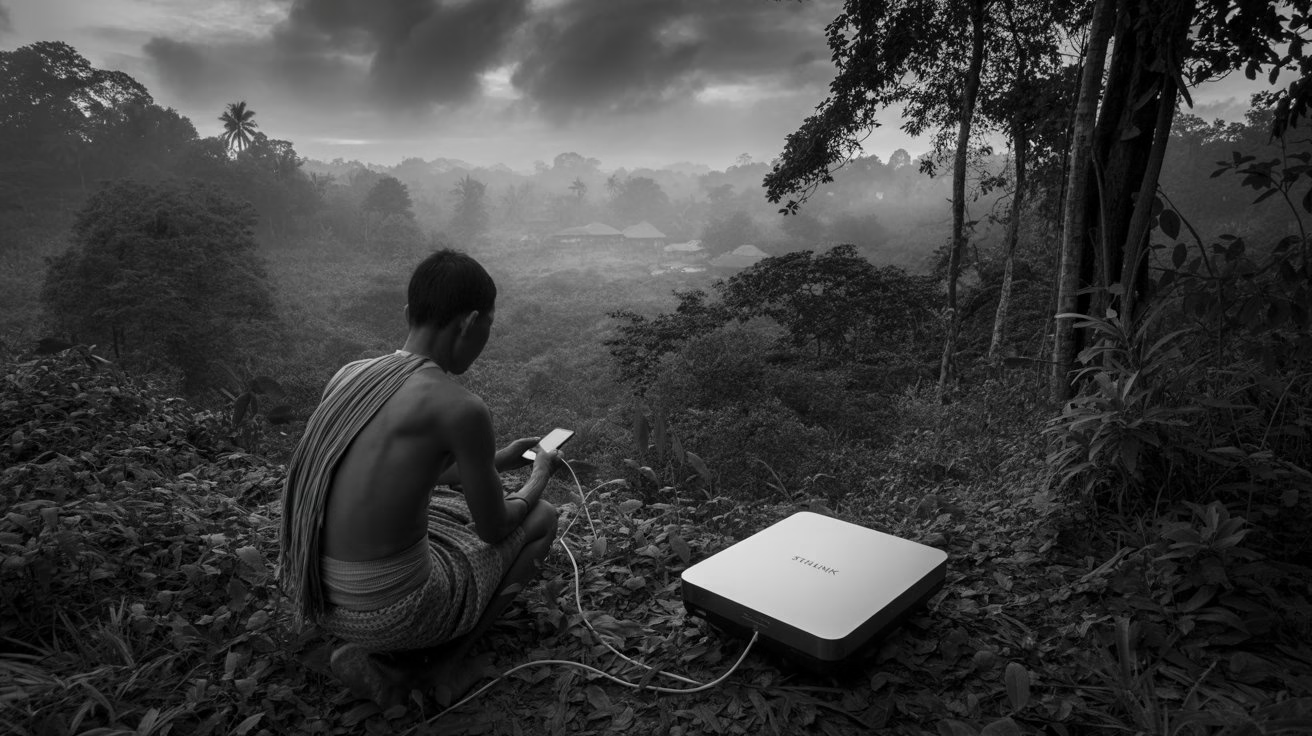
U.S. Congress Starlink investigation threatens internet access in Myanmar
A U.S. Congressional investigation into the use of Starlink by scam centres in Myanmar risks a blunt and disproportionate response that would further undermine the rights of a vulnerable population already suffering from repression, conflict, and poverty. Read >
-
Predicting rights violations in Myanmar’s sham elections
The military’s 2025 election is a pre-scripted exercise in repression, designed to create a façade of legitimacy while violating fundamental human rights. A predictable blueprint of violations is unfolding, from eliminating political opposition and criminalising dissent to weaponising state media. The process will culminate in a fraudulent vote in a climate of fear, with ethnic minorities facing severe disenfranchisement. One of the election’s purposes is to provide a pretext for… Read >
-
Are 21,300 child deaths from foreign aid cuts a crime against humanity?
Of the 13 million excess deaths projected worldwide by 2030 due to the U.S. decision to cut aid, 165,000–200,000 may die in Myanmar alone—among them 21,300 children. This massive, preventable loss of life raises the urgent question: Do foreign aid cuts constitute an international atrocity crime? And if not, why does international law fail to hold donors accountable for such catastrophic and reckless acts? Read >
-
Nepal, Bangladesh, and the hard road to human rights in Myanmar
Recent and rapid change among Myanmar’s neighbours has brought a moment of profound hope. In Bangladesh, a youth-led uprising has led to a new government headed by a Nobel laureate civil society leader. In Nepal, a similar youth-driven movement has appointed a bold anti-corruption judge as the first woman to lead an Asian country without being the wife, daughter, or sister of a powerful man. Read >
-
Sweden ends development aid to Myanmar, abandoning media and civil society
Sweden will end all development aid to Myanmar from 2026, following the U.S. government. This includes $2.65 million per year for media and human rights groups. The shock decision, confirmed on 11 September 2025, is a profound blow to Myanmar’s civil society, human rights defenders, and independent media, severing a final and critical lifeline of support in the face of a brutal military regime. Read >
-
Myanmar’s repressive use of AI to counter “terrorism”
The military in Myanmar is engineering an artificial intelligence-powered digital dictatorship under the false pretext of national security and counter “terrorism”. This is not merely a collection of surveillance tools but a core component of the military’s campaign of repression, designed to automate and scale up atrocity crimes against the opposition. Read >

-
Fourth draft Sagaing Constitution lacks fundamental rights
The fourth version of the draft Sagaing Constitution continues to mark a shift toward public participation and transparency in law-making and includes positive changes. However, significant human rights issues remain. Many essential civil and political rights are still missing, and new vague language has been introduced that could enable future violations. Read >
-
Analysing 4 years of journalist detentions in post-coup Myanmar
The military detained 221 journalists from over 100 media outlets in the four years following the coup. Human Rights Myanmar assisted in the publication of ICNL’s comprehensive investigation into arrests, criminal proceedings, sentencing, and releases, highlighting specific rights violations. The report also examines the editorial positions of targeted media outlets and the distinct treatment of women journalists. Read >
-
Privacy violations and discrimination in Myanmar
Since the 2021 coup, Myanmar’s military has weaponised digital tools to dismantle privacy and target marginalised groups. This submission to the UN High Commissioner documents discriminatory surveillance practices—such as data retention, SIM registration, VPN blocks, and facial recognition—and calls for urgent international action to expose, sanction, and end the military’s deliberate strategy of digital repression and exclusion. Read >
-
Disinformation as a weapon in Myanmar
Disinformation is a deliberate, state-sponsored tactic used to silence dissent, justify violence, and undermine human rights. Spread through military-controlled media and covert online networks, it distorts reality and fuels division. Harmful counter-measures often worsen repression, while weak responses from digital platforms allow falsehoods to thrive. Independent media and global cooperation are urgently needed to counter this crisis. Read >
-
Military prevents reintegration of political prisoners
This report to the UN exposes the military’s deliberate policy of preventing the reintegration of political prisoners. Instead of rehabilitation, the military regime enforces surveillance, harassment, economic exclusion, and family disruption to keep former detainees marginalised and politically silenced. It calls for international accountability and support for independent reintegration efforts to counter the regime’s systematic repression. Read >
-
Risks of creative AI in Myanmar
Global tech companies have repeatedly rolled out new digital applications in Myanmar without adequate due diligence, driving disinformation, hatred and enabling atrocity crimes. As AI now enables instant audio-visual creation, it is critical that companies adopt rigorous, rights-based safeguards to avoid repeating these errors. Read >
-
Sex-based violence in Myanmar
Myanmar’s military systematically uses sex-based violence to subjugate women and girls, intensifying since the 2021 coup. At least 380 women have been intentionally targeted and killed, some burned alive or executed in custody, while over 500 have faced sexual violence, including rape. This deliberate strategy, rooted in patriarchy and militarisation, aims to silence dissent and erase women from public life. The report demands international accountability, survivor protection, and action against… Read >
-
Hundreds of older people victims of military violence
Older people in Myanmar are not spared from the conflict’s extreme violence. Since 2021, nearly 700 have been unlawfully killed. Military actions include horrific abuses like beheadings and being burned alive. Many, especially those with disabilities, are trapped and deliberately targeted. Alongside arbitrary detention of almost 500 and harsh sentences, these acts highlight a systematic assault. Urgent international action is needed to protect them. Read >
-
Military’s earthquake response: a crime against humanity?
The devastating 7.7-magnitude earthquake that struck Myanmar on 28 March has wrought widespread destruction and immense human suffering, made far worse by the military’s response, which may constitute another crime against humanity. Read >
-
Facebook whistleblower alleges “careless” management failed Myanmar
The newly published book Careless People, by Facebook’s former director of public policy Sarah Wynn-Williams, alleges that the company’s management was “deeply unconcerned” about its role in Myanmar, which helped “enable posts that led to horrific sexual violence and genocide” against the Rohingya minority group. Read >
-
Journalists under attack for defending Myanmar’s environment
Myanmar journalists reporting on environmental degradation have faced systematic violence, arbitrary detention, and torture. Reporters investigating illegal mining, deforestation, and industrial pollution—vital to public health and democratic accountability—are deliberately targeted by the military and a manipulated justice system. This report highlights severe human rights abuses for the UN’s global review. Read >
-
Myanmar’s digital coup rigging the election before it begins
The digital space plays a crucial role in modern electoral processes, especially in contexts like Myanmar, where the media landscape is tightly controlled, and online platforms remain one of the few avenues to access information. This report highlights how the military’s attacks on internet access and digital freedoms will further undermine the military’s plan to hold an election in 2025, which it claims will be free and fair. Read >
-
Chinese security companies exacerbate human rights violations in Myanmar
The rise of Chinese private security companies in Myanmar will reshape conflict dynamics. This report to the UN Working Group on the Use of Mercenaries highlights how such companies are proxies for the Chinese State, importing authoritarianism, intensifying militarisation, undermining human rights, and exploiting legal loopholes to operate with impunity. Read >
-
America cuts $1.1 billion for Myanmar, abandoning democracy and rights
The United States has cancelled aid contracts, effectively ending all support for Myanmar for the foreseeable future. This includes a predicted $259 million for 2025, with $45 million earmarked for democracy, human rights, and independent media projects. Read >






Join 2,000+ subscribers
Stay in the loop with everything you need to know about human rights in Myanmar.