Human Rights Myanmar publishes a range of in-depth investigative reports and advocacy statements. These publications provide detailed analysis and critical insights on significant human rights issues in Myanmar and beyond, offering authoritative information and expert recommendations on key matters of justice and human rights.
Recent in-depth reports
-

Myanmar freedom on the net 2026
Myanmar remained the joint-worst country in the world for internet freedom in 2026, scoring 9 out of 100 points. More >
-

A year of hate speech and Facebook moderation in Myanmar
A decade after the worst anti-Rohingya incitement on social media, and a year after Facebook announced it was reducing some moderation, HRM monitored over 600 hate speech posts across Facebook, Telegram, and TikTok to assess how the platforms responded. This Pulitzer-supported report focuses on Facebook, where half the hate posts were deleted while HRM watched,… More >
-

News audience suppression under Myanmar’s digital coup
Military shutdowns, blocks, surveillance, and rising costs have cut public access to independent media by 48%. Yet, 12 billion data points show most people distrust the military and actively avoid its propaganda, reflecting a resilient public sentiment. More >
-
The impact of digital platforms on Myanmar’s media during the 2025–6 elections
The exile media has become increasingly reliant on digital platforms to inform the Myanmar public. Such reliance has exposed the media to regular attacks from the military, its allies, and the platforms themselves. This report surveys over 40 media outlets to uncover their experiences before, during, and after the 2026 elections. It was produced in… More >
-

How the military blocked independent media during the 2025-6 elections
This groundbreaking report uses big data to reveal how the military intensified internet blocking of independent media, social media platforms, and VPNs during the sham elections, aiming to prevent the public from accessing any independent reporting or communicating with each other. More >
-

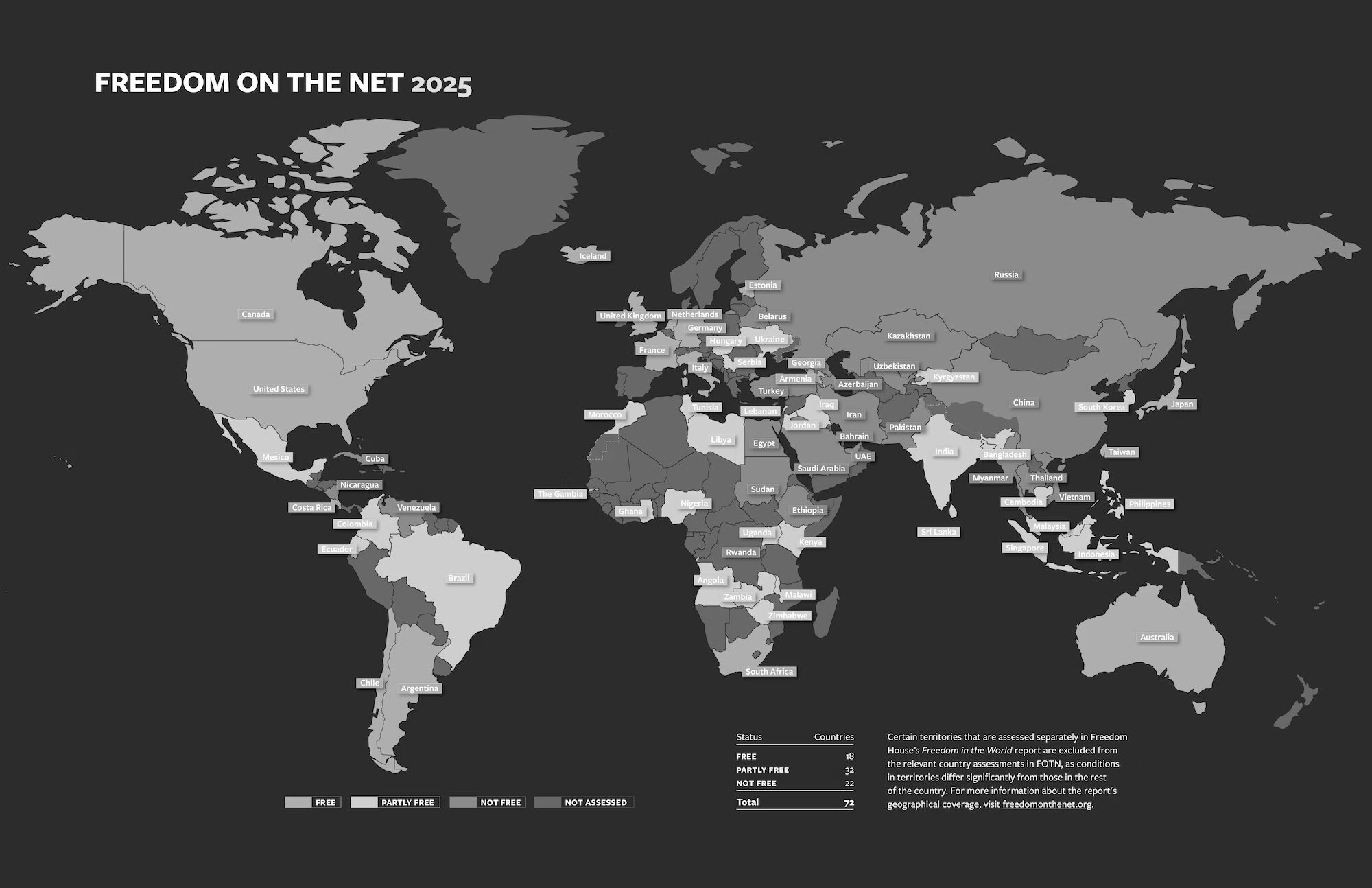
Myanmar freedom on the net 2025
This year’s Freedom on the Net report finds that internet freedom in Myanmar remained one of the worst in the world, alongside China, with a score of 9 points out of 100. The military’s installation of advanced deep packet inspection technology and the resulting VPN block significantly worsened the situation, shifting the country from basic… More >
-

Civic aftershock: How restricting civil society obstructed Myanmar’s earthquake response
After six months of interviews and research, a new report explains how the military deliberately obstructed the 2025 earthquake response, exploiting the humanitarian crisis to suppress civic freedoms. ICNL’s comprehensive report, based on key informant interviews with earthquake respondents, details how the military weaponised laws, imposed a complex system of permissions, and blocked access to… More >
-

Analysing 4 years of journalist detentions in post-coup Myanmar
The military detained 221 journalists from over 100 media outlets in the four years following the coup. Human Rights Myanmar assisted in the publication of ICNL’s comprehensive investigation into arrests, criminal proceedings, sentencing, and releases, highlighting specific rights violations. The report also examines the editorial positions of targeted media outlets and the distinct treatment of… More >
-

The Great Firewall of Myanmar
The military’s May 2024 VPN block has significantly infringed on digital rights. Human Rights Myanmar’s review of 3 billion Facebook interactions shows a substantial decline in public engagement on Facebook, impacting media, development, and the digital economy. The VPN block, combined with the Facebook ban, may be the largest act of censorship in Myanmar’s turbulent… More >
-
Myanmar freedom on the net 2024
Internet freedom in Myanmar deteriorated again from 2023 to 2024 and the country is now one of the worst in the world alongside China. The military’s VPN block in May 2024 significantly worsened the situation, shifting the country from basic to advanced digital repression. More >




Other publications
-
Myanmar freedom on the net 2026
Myanmar remained the joint-worst country in the world for internet freedom in 2026, scoring 9 out of 100 points. More >
-

Myanmar’s “new” government continues culture of military secrecy
Myanmar’s “new” government has not led to any improvements in transparency since the 2025-26 contested elections. On International Right to Know Day, 28 September 2026, Myanmar’s public still lacks reliable, comprehensive, and accessible information about basic matters of public interest, including public finances, corporate ownership, judicial decisions, the conflict, and displacement. More >
-
Psychological impact of repression in Myanmar
Human rights defenders in Myanmar bravely face burnout, trauma, fear, and self-censorship amid conflict, surveillance, criminalisation, and displacement. This UN submission argues that psychological harm is not only a consequence of repression but also a mechanism that weakens civic space, collective action, and the long-term sustainability of human rights movements. More >
-
Protecting Myanmar’s environmental defenders in conflict
Environmental defenders in Myanmar face criminalisation, violence, and displacement while protecting land, water, forests, and communities. This submission to the UN’s review examines conflict-linked extraction, rare-earth supply chains, and collective protection, calling for accountability, safe participation, effective remedies, and sustained support for indigenous environmental governance and community-led stewardship nationwide. More >
-
A year of hate speech and Facebook moderation in Myanmar
A decade after the worst anti-Rohingya incitement on social media, and a year after Facebook announced it was reducing some moderation, HRM monitored over 600 hate speech posts across Facebook, Telegram, and TikTok to assess how the platforms responded. This Pulitzer-supported report focuses on Facebook, where half the hate posts were deleted while HRM watched,… More >
-

200 million datapoints show general public still rejects military rule
Our recent report on the military’s suppression of independent media during Myanmar’s elections included a rare, data-driven picture of public attitudes toward military rule since the 2021 coup, based on sentiment analysis of 194.7 million Facebook reactions. More >
-
Myanmar’s delayed UPR shows more failed UN protection
The UN’s ongoing delay of Myanmar’s Universal Periodic Review (UPR) has undermined international scrutiny of the country’s human rights record. Myanmar’s third UPR was never completed in 2021 following the coup, and the fourth, originally scheduled for January 2025 but pushed to January 2027, is now also in jeopardy. More >
-
News audience suppression under Myanmar’s digital coup
Military shutdowns, blocks, surveillance, and rising costs have cut public access to independent media by 48%. Yet, 12 billion data points show most people distrust the military and actively avoid its propaganda, reflecting a resilient public sentiment. More >
-
Regime’s proposed Anti-Online Fraud Law targets dissent, not scams
The proposed Anti-Online Fraud Bill is not a genuine response to cybercrime, but a repressive tool of military control. Framed as an anti-scam law, it expands mass surveillance, censorship, arbitrary asset seizures, and disproportionate punishment, threatening digital dissent, alternative financial networks, humanitarian action, and fundamental human rights across Myanmar. More >
-
The impact of digital platforms on Myanmar’s media during the 2025–6 elections
The exile media has become increasingly reliant on digital platforms to inform the Myanmar public. Such reliance has exposed the media to regular attacks from the military, its allies, and the platforms themselves. This report surveys over 40 media outlets to uncover their experiences before, during, and after the 2026 elections. It was produced in… More >
-
Myanmar Submission on the safety of journalists for UN Resolution 59/15
The military has turned laws, courts, and digital infrastructure into tools to hunt journalists. This submission for UN Human Rights Council Resolution 59/15 documents mass detentions, lawfare, digital surveillance, gendered online violence and exile, and argues that protecting journalists now depends on independent civil-society frameworks rather than State mechanisms. More >
-
Protecting women and children in Myanmar’s conflict
Women and children have been subjected to severe human rights violations since the coup in Myanmar. This report provides a formal submission to the UN High Commissioner for Human Rights regarding Resolution 60/19. It documents the targeting of women and children, advocating for comprehensive reparations, international accountability mechanisms, and the protection of fundamental human rights. More >
-
Protecting Myanmar’s HRDs in the digital age
Myanmar’s human rights defenders are facing significant digital attacks in response to their work. This report was submitted to the UN Office for the High Commissioner for Human Rights, which is doing a global review of digital attacks. More >
-
How the military blocked independent media during the 2025-6 elections
This groundbreaking report uses big data to reveal how the military intensified internet blocking of independent media, social media platforms, and VPNs during the sham elections, aiming to prevent the public from accessing any independent reporting or communicating with each other. More >
-

11 recommendations for proposed national human rights law
The proposed National Human Rights Law must prioritise international law and extend protection to all displaced and stateless persons. A conflict-sensitive mandate, judicial-grade independence for commissioners, and mandatory government responses to findings are essential. Without these structural reforms, the Commission risks failing Myanmar’s most marginalised populations in a contested environment. More >
-

Military elections fail 5 key international standards
This report evaluates the 2026 Myanmar elections against international human rights law. The systematic audit across five legal pillars reveals a total collapse of international standards, characterised by State-sponsored coercion and structural disenfranchisement. This exercise was not a genuine election and the international community should make a principled rejection. More >
-
Impact of digital surveillance on civic space in Myanmar
The military is weaponising surveillance to crush all civic space. AI-powered cameras and spyware are used to hunt journalists, human rights defenders, and political activists, while repressive new laws create a “rule by lawfare.” This digital dictatorship enables a high-tech war on women and criminalises the very act of seeking privacy. More >
-
AI undermines cultural life in Myanmar
The military is weaponising Artificial Intelligence to dismantle cultural rights and undermine the right to development. By automating censorship, enforcing digital exclusion, and erasing minority identities, the military has created a digital dictatorship. This submission details how AI-driven repression violates international law and demands urgent global accountability. More >
-
The effect of digital repression on transitional justice in Myanmar
Myanmar’s digital dictatorship creates significant barriers to transitional justice. While new technologies offer vital evidentiary tools, the military weaponises AI, biometric surveillance, and internet shutdowns to criminalise documentation and erase digital memory. This report to the UN calls for global evidence preservation protocols and digital restoration to protect the right to truth. More >
-

Civil rights approach to accountability and transitional justice in Myanmar
Accountability is not only about punishing physical atrocities. It requires dismantling the structural machinery of oppression. This submission to the UN’s review explains that true justice in Myanmar involves restoring the rule of law and ensuring the protection of fundamental freedoms. More >