

Summary
Military shutdowns, blocks, surveillance, and rising costs have cut public access to independent media by 48%. Yet, 12 billion data points show most people distrust the military and actively avoid its propaganda, reflecting a resilient public sentiment. This report was produced in partnership with IPCM and is also available in Myanmar language.

Jump to:
Executive Summary
Since the 2021 coup, the military has systematically made access to media a high-risk activity for the public. This report, one of a series on media freedom up to and during the 2025-26 sham elections, analyses 12 billion Facebook data points and reveals the impact of military shutdowns, blocks, and surveillance, more expensive data, and platform algorithms on media audiences.
Key Findings
- Media outlets increased their total Facebook output by +18% despite the criminalisation of journalism, with regional media production growing by +108% since the coup.
- Military-enforced internet shutdowns, blocks, and rising data costs, combined with platform algorithm changes, have cut public access to media by -48% in a systematic act of censorship.
- The public has avoided military propaganda, with views of military-affiliated media falling by -76% in favour of more independent reporting.
- Extensive digital surveillance has caused shares and comments on media posts to drop by -63% and -42%, in a sign of mass public self-censorship.
- The digital public square is becoming polarised, as views of more impartial media fell by -70%, and people increasingly sought partisan echo chambers.
While the military has failed to control the media, it has succeeded in turning a universal human right into a high-risk and costly activity. Reclaiming this digital space is no longer just a matter of media survival, but a necessity for the survival of the public’s right to information.
Introduction
Five years of systemic human rights atrocities have preceded the military’s attempt to finalise its coup objectives by holding long-promised elections phased between December 2025 and January 2026. The polls were widely condemned by the international community as a sham and failed to gain recognition from regional bodies, including ASEAN.
A previous report in this series documented how the military captured Myanmar’s digital infrastructure in advance of the elections, blocking access to the media. A second report showed how the media have faced systematic rights violations on social media platforms during the voting period.
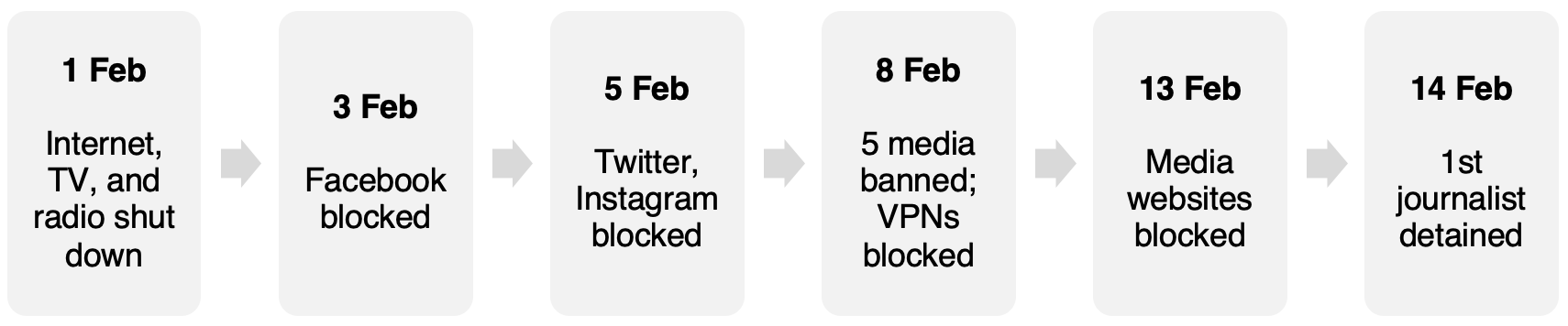
This report tracks the media on Facebook, comparing the pre-coup period in 2021 to the period during the contested elections from October 2025 to January 2026. It analyses the impact of the coup alongside the media’s parallel resilience. The first sections of the report are focused on understanding the scale and depth of the impact. The later sections look more closely at the different types of impact.
The findings are grounded in the standards in Article 19 of the International Covenant on Civil and Political Rights (ICCPR), and international programmes like the UN Plan of Action on the Safety of Journalists and the Issue of Impunity. They evaluate the extent to which the people of Myanmar can exercise their right to seek, receive, and impart information on Facebook. Through this lens, the report assesses the actions of both the military and global tech companies in following international human rights standards.
Methodology
To understand the impact of the military’s censorship, we conducted a longitudinal study of the media landscape on Facebook. We analysed 12 billion data points from a sample of 50 media outlets in 2021, 2025, and 2026.
This sample included Myanmar’s 15 largest outlets by Facebook audience size. The remaining 35 were carefully selected to represent the diversity of Myanmar’s media, including small regional and ethnic outlets, media established after the coup, State-owned media, and military-aligned outlets, commonly known in Myanmar as “crony media”, thereby allowing for sector-wide generalisable findings.
To measure the impact of the censorship, we compared data from the pre-coup period (January 2021) to the period surrounding the contested elections (October 2025 to January 2026). The data included posts, views, likes, shares, comments, and reactions, and was disaggregated across multiple dimensions of ownership, location, editorial stance, size, partisanship, and beat to compare changes between different types of media.
This report focuses on the digital public square via Facebook, Myanmar’s primary social media platform for information exchange.[1] While the dataset’s scale ensures statistical significance for digital trends, these findings describe the online ecosystem and should not be extrapolated to offline media audiences. Furthermore, while the dataset may include diaspora and exile use of Facebook, the size and consistency of the data mean that these external groups do not fundamentally alter the shifts.
Media output and operational resilience
Despite a violent campaign to silence them, Myanmar’s media have shown resilience. Under international law, the media have the right to report, yet in Myanmar, the military regards journalism as a crime and prosecutes journalists. The data shows that the media have not retreated. Instead, they have expanded their exercise of the right to freedom of expression to reach the public.
Quantitative increases in news
Since the 2021 coup, the combined number of Facebook posts by the 50 sampled outlets increased by +18% from 17 to 20 thousand posts per month.[2] The median number of posts per outlet also increased by +64% from 185 to 299, showing that the growth was not limited to a few large outlets but was sector-wide.
This reveals that the media have continued to operate despite military attempts to restrict their operations. While the military sought to create an information gap by arresting journalists and raiding newsrooms, the media filled that space with more publications than ever before.[3]
The rise of the independent media
The growth in the number of media posts has been driven almost entirely by independent outlets, despite them being the primary focus of military censorship. Independent media increased their output by +29% from 12 thousand to 16 thousand posts per month. This includes both older independent outlets and new ones established post-coup, such as People’s Spring. This represents a significant shift in how the public’s right to information is fulfilled in Myanmar.
Most of the independent media’s operations are now conducted from exile, demonstrating the principle of “imparting information regardless of frontiers” as protected by the ICCPR. These media operate a cross-border information flow, using digital tools to bypass the military’s physical border controls. Their work ensures that the military cannot use geography to hide its violations of international law.

The spread of local reporting
The overall growth in the number of posts is partly due to an increase in local-level outlets covering grassroots resistance movements in regions like Sagaing. Outlets based in Myanmar’s Bamar-majority administrative Regions, including Sagaing, grew by +108%. Those in the country’s ethnic minority administrative States, such as Karenni, grew by +70%. These rates are higher than the +11% growth in posts by national-level outlets.
Outlets based in Myanmar’s Bamar-majority administrative Regions, including Sagaing, grew by +108%
As conflict and repression grow, local media increase their focus on documenting the impact. Where the military prevents freedom of movement and often shuts down all communication, local-level media serve as an important source of information, particularly for local marginalised communities. They provide updates on troop movements, safe paths for displaced people, and evidence of local atrocity crimes. This documentation is not just for immediate news, as it serves as an archive for future legal accountability and justice for victims of human rights abuses.
Reduced information from military-affiliated media
While independent media have scaled up their production, military-affiliated outlets have reduced their posts, which are a mixture of entertainment and propaganda. State-owned media significantly reduced their posts by 35%. Military-aligned outlets, most of them television channels covering entertainment, minimally reduced their output by -2%.
State-owned media significantly reduced their posts by 35%
This decline represents a failure to deliver on the State’s positive obligation to provide the public with necessary information, services, and administrative updates. Under international standards, the State should not publish propaganda. But by withdrawing from its role as a legitimate information provider, the result will be a lack of awareness about many matters of public interest. Such information would cover healthcare issues, educational opportunities, and many other topics that the State controls.
Collapse in public access to news
While Myanmar’s media have increased their output, the public’s ability to access this information has significantly declined. This section measures the impact of the military’s use of various measures to disconnect the people of Myanmar from independent media, representing a violation of the right to access information.
Significant decline in audience size
Despite the media’s increase in posts, the total “reach”, or how many people actually see the content, has declined significantly since the coup. The combined audience reach for the 50 sample outlets declined by -48% from 4.7 billion “views” per month before the coup to 2.4 billion in 2026. The average number of views per post has declined even more sharply at -56%, dropping from 274,518 to 121,589.
The combined audience reach for the 50 sample outlets declined by -48%
The scale of this decline suggests significant barriers to information flows rather than natural changes in audience behaviour. It indicates that a large proportion of the public no longer has access to the vital information they need to make decisions about their lives and safety. Furthermore, the significant loss of access to information during an election period raises concerns about disenfranchisement, undermining the foundation of any free and fair process.

The large decline in military-affiliated media reach
The drop in audience reach has affected most outlets, but the impact has not been equal. Military-affiliated outlets, including State-owned and military-aligned media, have seen their reach decline by -76%. This large loss of audience is demonstrated by the examples of Channel 9 Myanmar’s -99% decline, Eleven’s -84% drop, and MRTV-4’s loss of -62%.
Although State-owned and military-aligned media are filled with propaganda and disinformation, the military remains obligated to inform the public on matters of interest. By prioritising propaganda, the military discourages the public’s attempt to access reliable and relevant information. The broader impact will be that any accurate information published by the State will have a smaller audience reach, too.

Countering audience decline with virality and quality
Independent media audiences have also declined in size, albeit not as much as for military-affiliated media. They have faced an average decline in reach of -23%. This average figure masks the severity of the decline for many of Myanmar’s largest and most established independent outlets, which have seen their audiences shrink by as much as -45%.
This loss of audience undermines the media’s ability to serve the public interest. It also threatens media sustainability because independent outlets increasingly rely on income from platforms like Facebook for financial viability. The decline also suggests that millions of people are unable to exercise their right to information.
A few independent outlets have used virality and quality strategies to defy the trend. The Myanmar Press Photo Agency grew its total reach by +1,704%, Khit Thit Media increased by +1,365%, and Kachin Waves’ audience rose by +788%. Other outlets, such as BBC (Burmese), Kachin News Group, and Myanmar Now, have focused on small-volume-high-impact strategies, maintaining influence with 636, 487, and 475 thousand views per post, respectively. Although any concentration of reach around a few outlets creates risks for media pluralism, it also demonstrates that the public’s demand for independent reporting can overcome digital censorship.
The causes of audience decline
The gap between increased media posts (+18%) and declining audience reach (-48%) represents a threat to the public’s right to receive information. This section analyses the technical, algorithmic, and economic barriers that have obstructed information flows in Myanmar.
Blocked by the military’s “Great Firewall”
The primary cause of the decline in audience reach is likely the military’s technical campaign to block the public from accessing news. Following the coup, the military started building a “Great Firewall” by ordering internet shutdowns and blocking access to Facebook and independent media websites. The firewall was escalated during the 2025-26 election period. When the public turned to Virtual Private Networks (VPNs) to circumvent the firewall, the military responded by effectively banning these tools. They criminalised people for trying to avoid the firewall.
The firewall violates everyone’s rights, but is even more severe for marginalised groups. People in rural areas with slower connections, those with lower levels of digital literacy, communities dealing with conflict, and women facing intersectional pressures, among others, face greater barriers to circumventing the firewall. These actions represent a systemic violation of Article 19 of the ICCPR, as they strip the public of their right to seek and receive information.
The surveillance chilling effect
Another likely cause of the decline of media reach is the military’s use of surveillance technologies and device searches, followed by the criminalisation of internet use. The understandable concerns of being monitored online, exposed while responding to independent news, or caught at a checkpoint with a VPN app have led people to change whether and how they interact with information online.
By making the digital public square a site of constant monitoring, the military has dismantled the safety required for a free and open information environment
This environment constitutes an unlawful interference with the right to privacy under Article 17 of the ICCPR. Rather than participating in open debate, the public is being forced into surveillance-induced self-censorship. People balance their right to information with the immediate need for personal safety. By making the digital public square a site of constant monitoring, the military has dismantled the safety required for a free and open information environment.
Increased cost and platform “Enshittification”
The increased cost of accessing the internet has undoubtedly contributed to the decline in media reach. After the coup, the military intentionally made access prohibitively expensive by imposing a SIM card purchase tax, tripling telecommunications firms’ corporate tax, and ordering operators to double the price of data. The overall cost is also increased by the “enshittification” of major platforms like Facebook, bloated with advertising, tracking, videos, and non-essential features.
Digital poverty acts as a form of economic censorship
For people in Myanmar living on small budgets, accessing the media now consumes significantly more money than before the coup. As the military’s actions have severely impacted the economy, data has become more costly. Digital poverty acts as a form of economic censorship, ensuring that the right to receive information is restricted to a wealthier minority.
The problematic role of algorithms
Decisions made by social media platforms may have exacerbated the decline in reach.[5] Changes to Facebook’s algorithms seem to have shifted the digital public square toward private individuals’ content, often at the expense of views and clicks for independent outlets. For Myanmar’s media, this has contributed to a crisis of algorithmic censorship, where independent reporting is downranked, or “shadow-banned” alongside military propaganda.
This has contributed to a crisis of algorithmic censorship, where independent reporting is downranked, or “shadow-banned”
Under the UN Guiding Principles on Business and Human Rights (UNGPs), digital tech companies have a responsibility to ensure their operations do not worsen human rights crises. In Myanmar, the lack of transparent, rights-based decision-making means that algorithmic shifts can extend the military’s information gap, prioritising sensationalism and disinformation, and making it harder for the public to find verified facts during times of conflict.
Forced migration to other platforms
Technical, surveillance, and economic barriers may also be forcing people to migrate away from Facebook to platforms that are cheaper to access, potentially less monitored, and unblocked.[6] While platform migration is typically a sign of a healthy market, forced migration in Myanmar risks harming both individuals and society.
Human rights protections vary significantly across these services. After much criticism, Facebook has invested in Myanmar-language moderation and maintains a formal commitment to the UN Guiding Principles on Business and Human Rights (UNGPs). In contrast, some alternative platforms lack moderation entirely, or use inadequate AI-powered tools, and have no formal human rights policies.
This forced migration also risks pushing the public into fragmented information silos. When a society is split into separate communities with no shared reality, the possibility for democratic reconciliation and a pluralistic public square disappears. This fragmentation represents a long-term cost to peace and justice in Myanmar.
The chilling effect on audience engagement
Military repression has not only led to a decline in media audiences but also changed how audiences respond to the content, including by shifting toward safer forms of engagement to avoid detection. This section analyses how audience engagement has changed since the coup, balancing support for objective reporting against the threat of military surveillance.
Increased appreciation of the media
The “Like” function on Facebook has evolved from a simple social interaction into a rising tool for public solidarity and support for the media. While audience reach has declined, likes across the sample media posts have increased by +52%. This growth does not represent natural changes in audience behaviour, as it is almost exclusively directed toward independent media.[7] It shows that the public’s appetite to exercise the right to seek and recognise credible information remains resilient, even as access is restricted.
Likes across the sample media posts have increased by +52%.
Before the coup, military-aligned entertainment-focused television channels received the most engagement. By 2026, independent media saw a +126% increase in likes, indicating a public shift toward current affairs content. Similarly, the “view-to-like” conversion rate for independent media tripled from 0.58% to 1.70%.[8] Specific examples of this growth include DVB, which increased from 2.2 million to 5.6 million likes per month (+149%), Mekong News, which grew +653%, and Kachin News Group, which increased +452%. In contrast, military-aligned media saw likes decline by an average of -32%. Channel 9 and Eleven saw likes drop by -98% and -91%, respectively. This indicates that the public is showing appreciation for independent journalism and refusing to be coerced by military-aligned narratives.

The decline in dissemination
Public dissemination of media content through “Shares” has significantly declined, as promoting posts to a wider social circle is more visible to military surveillance. Shares of media posts dropped by -63%, falling from 4.8 million per month pre-coup to 1.8 million in 2026. This decline was not only due to lower reach, but also public behavioural change as the “view-to-share” conversion rate also fell by -28%, dropping from 0.1% pre-coup to 0.08% in 2026.[9] This shows a clear chilling effect on the right to impart information, as audiences have increasingly self-censored.
The decline of shares was not equal across media. Some outlets bucked this trend, such as the Myanmar Press Photo Agency, which increased shares by +2,041%, and Ayeyarwaddy Times, which increased by +303%. While self-censoring overall, a portion of the public remains willing to risk their personal safety to ensure information reaches the wider community.
Military-aligned and State-owned outlets saw the greatest decline in shares of -88% and -85%, respectively. This was far worse than independent media, which saw shares fall by -38%. This divergence reveals a growing public refusal to help disseminate military propaganda.

The silencing of public debate
The clearest indicator of the chilling effect on freedom of expression is the decline of public discussion. “Comments” on media posts, which are easily visible to surveillance, fell by -42% between 2021 and 2026. This drop represents the silencing of the digital public square, where the fear of surveillance has undermined the communal deliberation necessary for any society.

The decline in comments was most severe for State-owned and military-aligned media, which fell by -52% and -39% respectively, compared to a -29% drop for independent media. Eleven and MRTV-4 lost -84% and -52% of their comments. The disproportionate loss of comments on military-affiliated media shows that the public is actively withdrawing its participation from the military’s information space, rather than ceasing all public debates.
Despite the overall decline, some independent media saw growth in comments. The Myanmar Press Photo Agency received an increase of +4,319%, Kachin Waves saw +1,382%, and Ayeyarwaddy Times gained +1,096%. The growth in discussion on some independent outlets shows that the public’s need for communal discussion remains a vital act of social bonding and resilience.

Editorial stances and polarisation
This report has shown the direction and scale of change in media information flows on Facebook after the coup. Media and their audiences have developed in other ways, too, particularly in the content of what they publish. This section analyses how the military’s attempts to control the narrative have led to shifts in editorial stances, and how that affects society.
The emergence of pro- and anti-military editorial stances
The military has failed to force the media into obedience or stop the growth of defiant anti-military editorial stances since the coup. Under international human rights law, the right to freedom of expression protects the independence of the media. This includes the right of the media to take a political or adversarial editorial stance, provided that the outlet is not publicly funded or using the public broadcast spectrum.[10] The public also has a right to access diverse information from a range of editorial stances.
Anti-military media responded to the coup by increasing their posts by +73%. Pro-military media had the opposite response to the coup, reducing their output by -31%
Myanmar’s media fall along a spectrum ranging from a very anti-military editorial stance to impartial to very pro-military.[11] Editorial stance is not entirely defined by ownership, because, for example, an independent outlet could be editorially impartial, somewhat anti-military, or very anti-military.[12] Impartial media maintained their number of posts following the coup at -3%. Somewhat anti-military and very anti-military media responded to the coup by increasing their posts by +73%. This shows that anti-military media responded to the coup by trying to fulfil the public’s right to access a diversity of information.
Somewhat pro-military and very pro-military media had the opposite response to the coup, reducing their output by -31%. This indicates that the priority of outlets with a broadly pro-military stance was to reduce information in the digital public square. Pro-military media preferred to publish nothing rather than offer editorial support to the coup.
The public boycott of the military narrative
A large portion of the public dislikes pro-military narratives, including those promoted by individual military-affiliated outlets. While previous sections showed declines in views and engagement with State-owned and military-aligned media, the public response is driven more by editorial stance than by the outlets themselves. The reach of media with broadly pro-military stances declined by -80% after the coup, compared to anti-military outlets, which saw their reach increase by +15%. This shows a collective public attempt to exercise their right to be free from harmful communication, including propaganda for war and incitement to hatred.
The public also increasingly avoided engaging with pro-military media, which saw likes decline by -26%, shares plummet by -90%, and comments drop by -72%. The anti-military media increased their likes by +274% and sustained their number of shares and comments (-2% and -8% respectively). The significant collapse of engagement for pro-military outlets indicates that the military has lost the consent of the governed within the digital public square.

Public support for exile media
The independent media have remained resilient despite their leaders, journalists, and newsrooms being forced into exile to avoid arbitrary arrest, confiscation of property, and closures.[13] Within a month of the coup, exile media produced 44% of all media posts. That proportion continued to rise, increasing by +71% to reach 63% in 2026. Most of the remaining posts came from State-owned or military-aligned outlets still operating inside Myanmar, although their proportion fell by -23%.[14] This puts into practice the ICCPR principle that the right to seek and impart information applies “regardless of frontiers”.
The public has supported the media’s efforts to stay independent. Within a month of the coup, exile media had 43% of all views. By 2026, that figure had risen to 70%. Public engagement also increased with likes rising from 40% to 64%, shares from 53% to 79%, and comments from 63% to 76%. Rather than losing their audience, exile media became more relevant, as many people saw their reporting as more independent, credible, and unbiased.
Declining public interest in impartiality
The public’s boycott of the military narrative has also involved a shift away from impartial media. While outlets with a more impartial editorial stance have maintained a regular number of posts (-3%), reach has declined by -70%. Public engagement with impartial media has also declined, with likes, shares, and comments dropping by -26%, -86%, and -71%, respectively. These rates of decline are similar to amounts seen by pro-military outlets.
The public’s growing avoidance of the digital public square’s middle ground weakens media pluralism and undermines people’s ability to form opinions freely. As impartial spaces decline, propaganda, disinformation, and polarised narratives crowd out balanced debate, eroding shared understanding and increasing vulnerability to manipulation.
Increased polarisation
Audiences have shifted from impartial media to more partisan outlets, deepening polarisation in public debate. People with moderately anti-military opinions increasingly turn to strongly anti-military media, while those with pro-military opinions cluster around strongly pro-military outlets. As a result, 24% of all views are now of highly partisan media, up from 18%. Since the coup, their proportion of shares doubled to 21%, and their comments tripled to 22%.
24% of all views are now of highly partisan media
As audiences move toward strongly pro- or anti-military media, highly partisan content gains reach and engagement, weakening balanced debate. While this may initially foster political solidarity on both sides, it ultimately deepens polarisation, fragments the public into “echo chambers”, and limits access to diverse perspectives. Often amplified by platform algorithms’ “rage-farming”, this undermines the right to form opinions freely, harms democratic debate, and weakens social cohesion, encouraging conflict.
Changes in public sentiment toward news
This report has examined the direction, scale, and nuances of changes to media information flows on Facebook after the coup. The rise of emoji “reactions”, seen globally but especially in Myanmar, because more overt forms of dissent have been criminalised, offers a more detailed understanding of audience opinion. This section analyses how these shifts in public sentiment reflect views of the media, its coverage, and the coup.

Supporting trusted media with “Love” reactions
A shift in “Love” Reactions towards the independent media shows increased affection, appreciation, emotional resonance, and trust. Before the coup, independent media captured 58% of all Love reactions. By 2026, this rose to 78% of all Love reactions. Local-level reporting contributed significantly to this shift, with Love Reactions increasing by +1,901%. Conversely, military-affiliated media saw their proportion of Love reactions halve, dropping from 42% to 22%. This shows increased desire to exercise the right to form an opinion without interference, and greater recognition of the legitimacy of non-State actors.
The shift in Love reactions also highlights a change in public sentiment toward political engagement. Before the coup, the highest proportion of Love reactions (57%) was given to entertainment channels with pro-military leanings. By 2026, most were directed at outlets with an anti-military editorial stance (66%). Growth in Love reactions for partisan media rose by +139% compared to +74% for impartial outlets. This demonstrates a shift toward a more serious sentiment when exercising the right to access information, reflecting the gravity of the coup on people’s lives.
Increased anger and shock at atrocities
Increases in “Angry” and “Wow” reactions provide a map of the public’s negative sentiment when accessing media. The proportion of reactions that were Angry tripled after the coup from 3% to 8%. Over the five years, they grew by +525% overall, but this growth was uneven. Angry reactions increased by +906% on independent media but dropped by -53% on military-affiliated outlets. This indicates an increase in the public’s desire to exercise the right to dissent in response to military repression, and to demand accountability for violations of the rights to life, liberty, and security of person.
Angry reactions increased by +906% on independent media
The proportion of Wow reactions may have dropped from 7% to 5%, but they still remain significant and reveal a public in shock. Wow reactions represent astonishment, amazement, and disbelief. They grew by +73% for the independent media but shrank for the military-affiliated media by -74%. The decline of Wow reactions on military-affiliated media shows a total breakdown of State credibility, representing a public rejection of propaganda that attempts to distort the right to credible information.
Collective grief through “Sad Face”
The growth of “Sad Face” reactions shows increased collective mourning. Since the coup, Sad Face reactions have grown by +365% overall, with 98% of this sentiment on independent media. Local-level media, which often cover human rights violations in depth, saw a +1,506% increase in Sad Face reactions. Media outlets with a pro-opposition editorial stance also saw an increase of +670%. A small proportion of Sad Face reactions are on posts by military-affiliated media (2%). This growth in collective mourning preserves public memory and reinforces the human dignity of those people whose fundamental rights have been violated by the military.
Local-level media, which often cover human rights violations in depth, saw a +1,506% increase in Sad Face reactions
Using the “Haha” reaction to “troll” independent media
The “Haha” Reaction has become a tool for “trolling” independent journalism rather than an expression of humour. It has grown in use by +117% since the coup and is found almost entirely on independent media posts. In 2026, there were over 2 million Haha reactions per month on independent media posts compared to just 7,000 on State-owned outlets. Adding these reactions to serious reporting is either dark humour or an attempt to troll, meaning harass or mock the media. It is intended to interfere with the media’s right to impart information without fear of harassment.
This trolling is most intense at the local level, where Haha reactions grew by +853%. Outlets with an anti-military editorial stance saw a +289% increase in these reactions, while it fell by -49% for pro-military media. This disparity indicates a coordinated effort to psychologically undermine the right to freedom of expression for the most vulnerable journalists operating in high-conflict zones.
Conclusion
The military’s restrictions have done more than limit the flow of information from the media to their audiences. They have fundamentally undermined the conditions necessary for an open and inclusive digital public square. By making access to media more costly, risky, and technically difficult, these measures have disproportionately excluded poorer and marginalised communities, deepening inequality in access to information and weakening the exercise of fundamental rights.
Repression has not translated into legitimacy
At the same time, repression has not translated into legitimacy. Continued public engagement with independent media, alongside the rejection of military-affiliated narratives, demonstrates the enduring importance of credible reporting in sustaining democratic resilience. Yet this resilience is being tested by pervasive surveillance, which has curtailed open participation in public debate and forced many forms of expression into quieter, less visible acts of dissent.
The longer-term risk is that this repressive information environment will not only suppress expression in the present but also reshape public discourse in ways that are harder to reverse. As audiences become fragmented across increasingly partisan and algorithmically siloed digital spaces, the prospects for shared understanding, inclusive dialogue, and future democratic reconciliation are placed at growing risk.
This points to the broader human rights concern that the military’s control over information is being used not simply to censor, but to restructure the public square itself. Protecting access to independent media, privacy, and the conditions for safe public participation is essential not only for freedom of expression but for any future democratic recovery.
Recommendations
- To align with its obligations under international human rights law, the military must immediately restore the public’s right to freedom of expression and information. This requires an unconditional end to internet shutdowns and blocks, the repeal of data taxes, and the cessation of surveillance-driven criminalisation of journalism and circumvention tools. All journalists detained for exercising their right to freedom of expression must be released and compensated.
- In accordance with the UN Guiding Principles on Business and Human Rights (UNGPs), tech companies, including Facebook, should urgently audit and overhaul algorithmic frameworks that deprioritise verified news. Tech companies must ensure that algorithms do not “shadow-ban” or downrank independent media.
- The international community and donors should prioritise flexible, long-term support for exile and local-level media outlets. Furthermore, rigorous sanctions should be applied against the technical infrastructure and entities responsible for orchestrating and facilitating the military’s digital repression.
- Independent media and civil society may use these findings to optimise editorial and distribution strategies to counter algorithmic silos, fulfilling the aim to provide accurate information and uphold the audience’s right to a pluralistic information environment under high surveillance.
Footnotes
[1] The use of social media platforms is difficult to quantify. Social media usage data is based on potential access rather than actual or sustained access. Data on social media use is published by the platforms themselves, based on advertising opportunities, and may therefore be unreliable.
[2] These figures have been adjusted to remove content that was repeatedly published. Approximately 5% of all media posts were duplicates of content that was previously posted. For a minority of media, the proportion of repeated posts was above 30%. The average for independent media was 5%.
[3] The dataset is primarily a quantitative measure of media production, which indicates whether the media remains in operation, and to what extent. Qualitative analysis can be conducted on the dataset, but the results would not be as reliable as an expert review of the content.
[4] Figures adjusted to account for content that was repeatedly published.
[5] It is not possible to measure the impact of these algorithmic changes alone due to a lack of platform transparency. However, it is clear from the disaggregated data that the decline is not caused by algorithms alone because various types of media have been affected differently.
[6] Platform migration is difficult to track. Internet usage datasets are based on potential access rather than actual or sustained access. Datasets on platform use are published by the companies themselves, based on advertising opportunities, rather than independent organisations, and may therefore be unreliable.
[7] Natural changes in audience behaviour would affect all media outlets similarly.
[8] The view-to-like conversion rate shows what proportion of views led to a like.
[9] The view-to-share conversion rate shows what proportion of views led to a share.
[10] While private media are free to be partisan, publicly-funded media and media that have been awarded broadcasting licenses to use the finite public spectrum have a different obligation. They must remain impartial to serve the whole population in the public interest. Under international law, the allocation of broadcast licenses should be a transparent public decision based on the public interest. In Myanmar, the military has historically gifted these channels to military-aligned companies in exchange for political support.
[11] For the purposes of this report, “pro-military”, “anti-democratic”, and “anti-opposition” editorial stances are treated as a single collective category, as are “anti-military”, “pro-democratic”, and “pro-opposition” stances. While individual media outlets may prioritise a specific editorial stance on one, they share a common political alignment at a structural level for the sake of analysing trends.
[12] The difference between anti-military and pro-military is not simply a matter of ownership and control. While all State-owned media are very pro-military, not all independent media are somewhat anti-military or very anti-military. Some independent media are impartial. A minority of private, and ostensibly independent, media have a broadly pro-military editorial stance.
[13] Only a small number of independent outlets did not go into exile, and they either closed, moved to areas under the control of ethnic organisations, or self-censored, changing their editorial stance to pro-military.
[14] A small proportion of the media posts produced inside Myanmar came from outlets operating from areas under the control of ethnic organisations.
This project was delivered with the support of an international donor organisation that has chosen to remain anonymous for risk management purposes.