
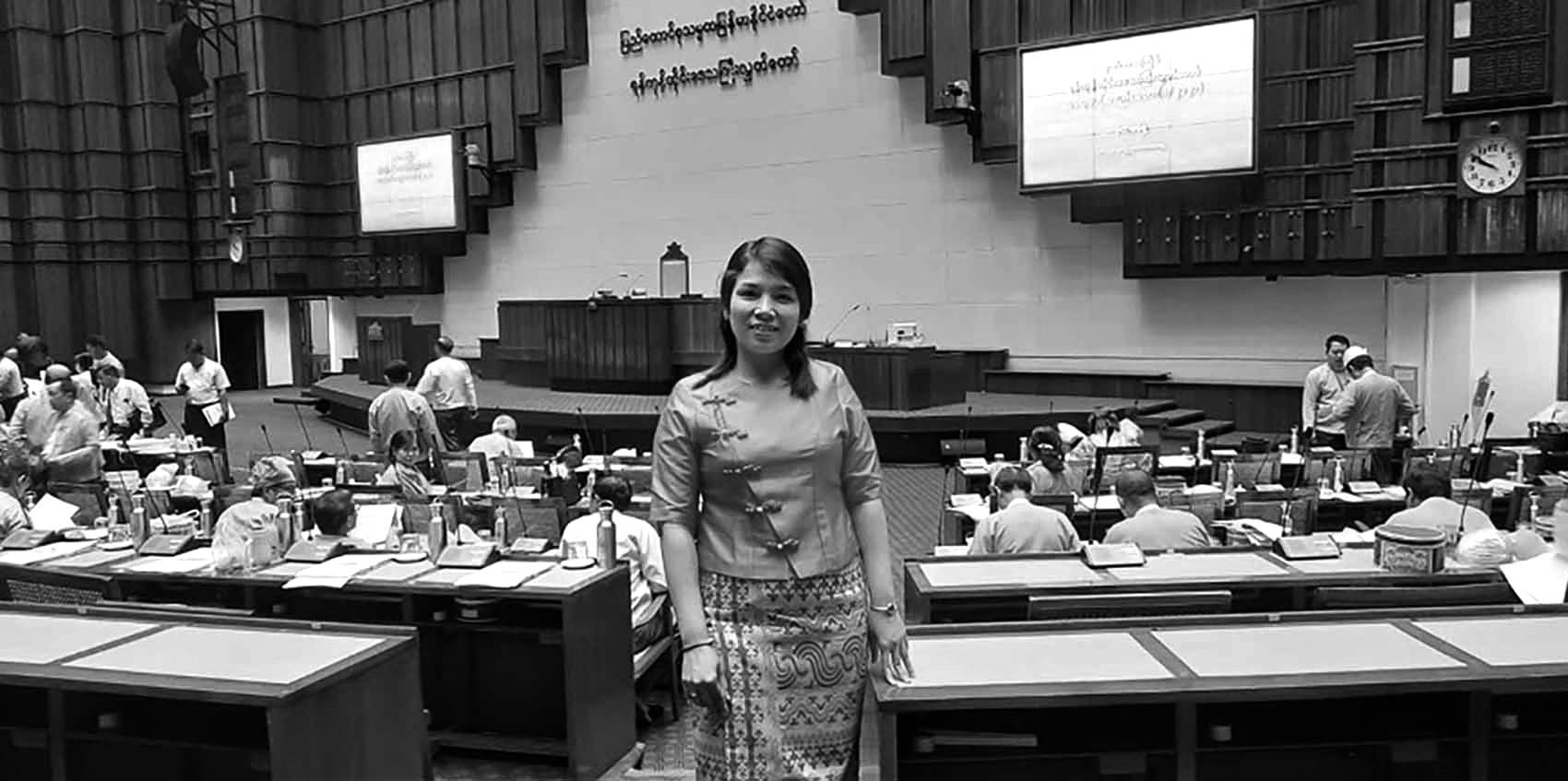
The investigation into allegations of misconduct and corruption within the Prime Minister’s Office offers a defining opportunity for the National Unity Government (NUG) to distinguish itself from the military regime.
The military routinely hides corruption, denies claims, and arrests complainants. The NUG has the chance to model a governance system grounded in human rights and the rule of law.
However, recent reports that the composition of the investigation team is being kept confidential are concerning. To truly demonstrate the integrity of the federal democracy it seeks to build, the NUG must reject such secrecy and ensure a transparent process that respects the human rights of both the whistleblowers and the accused.
Whistleblowing and the public interest
The investigation was triggered by complaints from 12 staff members. It is vital that the NUG views this not as an act of insubordination, but as a protected exercise of civic duty. Under the UN Convention Against Corruption, to which Myanmar is a signatory, the State has an obligation to protect persons who report offences in good faith from unjustified treatment (Art. 33).
Furthermore, the International Covenant on Civil and Political Rights (ICCPR) protects the right to seek, receive, and impart information (Art. 19).
The UN Human Rights Committee has explicitly stated that laws must not be used to stifle public debate regarding public figures (General Comment #34). Public officials are subject to a higher threshold of scrutiny than private individuals. The public interest in exposing misconduct generally outweighs the protection of an official’s reputation.
Consequently, the NUG must guarantee that the complainants face no retaliation. Framing good-faith internal complaints as “defamation” would contravene international standards and chill future accountability efforts.
Right to reputation and duty of care
While accountability is paramount, it must be equally recognised that the accused, Daw Kyi Pyar and U Nyi Nyi Min, possess fundamental human rights that the NUG is obligated to protect.
The Universal Declaration of Human Rights (UDHR) and ICCPR assert that “no one shall be subjected to arbitrary or unlawful interference with his privacy […] nor to unlawful attacks on his honour and reputation” (Art. 17.1).
This right is particularly important in the current conflict. NUG officials are already illegitimately designated as “terrorists” by the military. Publicly branding resistance leaders as corrupt before an investigation is concluded carries severe security implications.
The NUG has a specific duty of care to ensure its internal processes do not recklessly endanger the physical safety of its personnel. Fuelling military propaganda before facts are established puts lives at risk.
Therefore, the investigation must adhere strictly to the presumption of innocence (ICCPR, Art.14.2). The current suspension should be clearly communicated and treated as a neutral administrative measure rather than a punitive indication of guilt.
Due process in a legal void
The NUG cannot currently access a functioning, independent criminal court system. Therefore, this process must be understood as an administrative inquiry regarding fitness for office, not a criminal trial.
This distinction limits the punitive power of the committee but does not excuse it of the need for due process.
The principles of natural justice dictate that no one should be a judge in their own cause. Given the accused’s proximity to the Prime Minister, the investigation team must be demonstrably independent of the Prime Minister’s Office to ensure credibility.
Members of the investigation team, its process, and timeline must be transparent. The NUG must therefore reverse its statement of confidentiality.
Recommendations
To align this process with international human rights law, the following measures are recommended:
- Formalise whistleblower protections: Explicitly state that staff who report misconduct through official channels are immune from administrative retaliation or counter-claims of defamation.
- Ensure strict confidentiality and transparency: Impose a media blackout on the specific details of the evidence until the investigation concludes. Make the process and those involved completely transparent. This protects the reputation and physical security of all parties involved, while ensuring public confidence.
- Appoint independent adjudicators: Ensure the investigation committee is transparent and includes members from outside the executive branch, such as from the CRPH or civil society, to mitigate conflicts of interest.
- Clarify the standard of proof: Acknowledge that this is an administrative proceeding. If misconduct is found, sanctions should be administrative (e.g., removal from office) rather than criminal, as criminal penalties require a judicial standard of proof currently unavailable in the interim period.
Human Rights Myanmar offers its technical assistance to support the NUG in developing internal compliance mechanisms that meet international standards.
Footnotes
Image copyright to Kyi Pyar, Facebook