
Summary
This report evaluates the 2026 Myanmar elections against international human rights law. The systematic audit across five legal pillars reveals a total collapse of international standards, characterised by State-sponsored coercion and structural disenfranchisement. This exercise was not a genuine election and the international community should make a principled rejection.
Jump to:
This report assesses the recent Myanmar general election under key elements of international human rights law. It builds upon HRM’s earlier predictions for the elections. It is not a judgement on political ideologies or party allegiances of those involved, but a strict evaluation of the legal legitimacy of the electoral process.
To ensure an objective assessment, this report relies on General Comment No. 25, adopted as a standard-setting document by the UN Human Rights Committee in 1996. While Myanmar has not yet ratified the ICCPR, it is a member state of the United Nations and is therefore bound by the Universal Declaration of Human Rights (UDHR).
General Comment No. 25 is recognised by international legal experts as the authoritative interpretation of the shared principles in the ICCPR and UDHR. It provides the specific, measurable criteria for what constitutes a genuine election, moving beyond vague notions of fairness to set concrete requirements for candidate eligibility, voter safety, and structural equality.
HRM’s analytical framework
While General Comment No. 25 is a comprehensive legal document containing dozens of paragraphs, HRM has organised this analysis into five key areas. These areas are not listed as such in the General Comment itself. Rather, they represent HRM’s methodology for distilling the complex legal requirements into a clear, accessible framework. By grouping the Committee’s standards into these five pillars, HRM aims to provide a systematic audit of whether the core components of a legitimate election were present in Myanmar in 2026.
1. Genuine choice and the right to stand
The military regime failed to protect the right of every citizen to stand for election without discrimination, instead institutionalising political exclusion through the arbitrary dissolution of opposition parties and the weaponisation of conflict to restrict the ballot.
International law requires that elections offer a meaningful choice between competing political visions. According to Paragraph 15 of General Comment No. 25, the right to stand for office is a fundamental component of a genuine election, ensuring that voters are not restricted to a pre-approved list of candidates and that political affiliation is never used as a basis for exclusion.
Any restrictions on the right to stand for election must be “justifiable on objective and reasonable criteria.” Crucially, it forbids the exclusion of candidates based on political affiliation. This means that in a compliant system, a government cannot simply ban its opponents from participating in the democratic process to ensure its own victory.
In Myanmar, however, the military regime has systematically dismantled the political opposition to ensure that no genuine choice exists for the electorate. By utilising the Political Parties Registration Law (2023), the military-controlled Union Election Commission (UEC) enforced stringent requirements that effectively barred any party not aligned with military interests from participating in the national discourse.
A primary hurdle to this pillar in 2026 was the prevailing state of armed conflict. International law recognises that a genuine election requires an environment where voters can exercise their rights without fear. In Myanmar, the military has lost control of approximately 40-50% of the country’s territory. The phasing of the polls, which were split into three phases (28 December, 11 and 25) was a direct administrative admission of this instability.
A primary example is the National League for Democracy (NLD), which won a majority of elected seats in the 2020 polls but was dissolved by the UEC for refusing to re-register under the military’s new restrictive rules. Other large parties, such as the Shan Nationalities League for Democracy (SNLD), were similarly dissolved, leaving the ballot dominated by the military-backed Union Solidarity and Development Party (USDP) and its allies.
The exclusion also extends to the physical liberty of the candidates. Nearly all prominent opposition figures are currently detained or in exile. State Counsellor Aung San Suu Kyi and President Win Myint remain incarcerated under sentences widely viewed as politically motivated, a clear violation of the requirement that no person should suffer discrimination or disadvantage because of their candidacy.
Furthermore, the UEC itself lacks the independence required by international standards. In a system where the referee (the UEC) is appointed directly by one of the players (the military), the free choice of candidates is replaced by a managed selection process designed to fabricate a facade of democratic consent.
2. Freedom from coercion
The military regime violated the prohibition against manipulative interference and intimidation, replacing the voluntary expression of the electors’ will with a climate of compulsion enforced through military conscription and the withholding of basic rights.
For an election to be valid, the act of voting must be a voluntary expression of will. Paragraphs 11 and 19 of the General Comment emphasise that the State must protect voters from any form of intimidation, threat, or manipulative interference. This standard dictates that the environment must be free from compulsion, ensuring that the choice to participate or not to participate is made without fear of reprisal.
The UN standard requires that voters be able to form opinions independently and that States prohibit “abusive interference” with registration or voting. In the context of the Myanmar elections, these protections were entirely absent, replaced by a militarised environment where participation was treated as a mandatory display of loyalty to the regime. Holding an election under conditions of active civil war inherently violates the genuine requirement too, as a large portion of the electorate must risk their lives to participate. Even in areas designated as stable for the second phase of voting, conflict-related incidents including airstrikes and casualties were recorded, rendering the military’s definition of safety relative, not absolute.
The election process has been characterised by widespread State-sponsored coercion. The military weaponised basic services and legal threats to drive up voter turnout, targeting vulnerable populations such as internally displaced persons (IDPs) and civil servants to create a false appearance of public support for the polls.
For instance, during the first phase of voting on 28 December 2025, residents in Yangon and Mandalay reported being visited by local administrators who warned that failure to vote would be recorded. Authorities reportedly informed factory workers that they must take leave to vote and return with ink-stained thumbs as proof of participation, or face the loss of employment and potential imprisonment.
Furthermore, IDPs in central Myanmar were threatened with the withdrawal of humanitarian aid or the seizure of their property if they did not participate. The threat of conscription under the People’s Military Service Law was also used as a tool of electoral compulsion, with young people told that voting was a prerequisite for avoiding the draft.
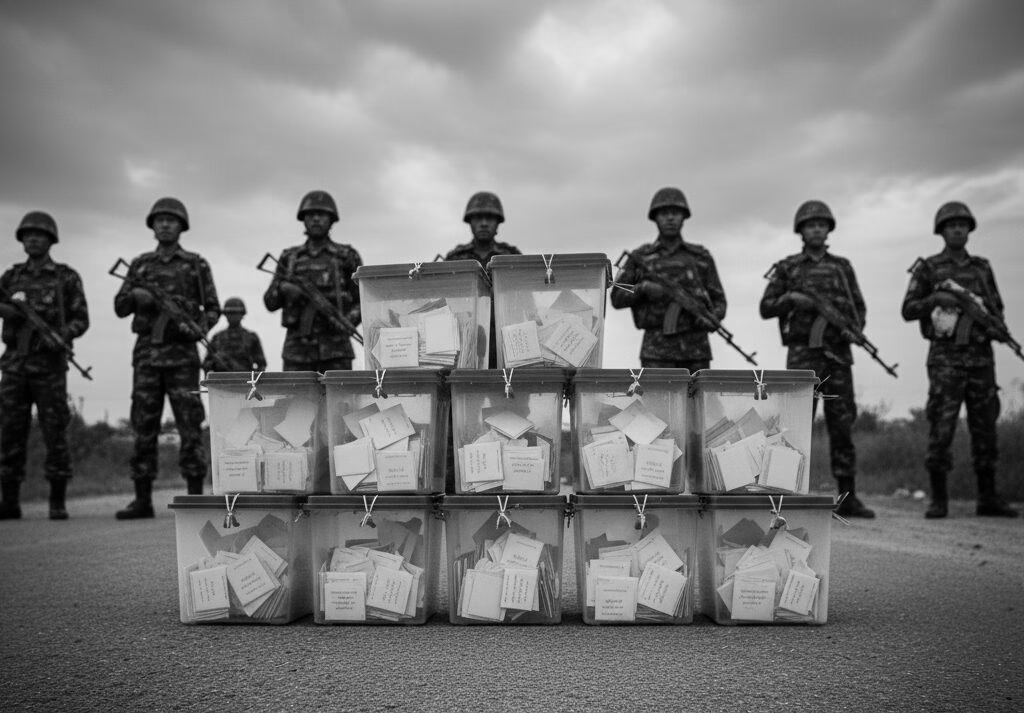
The atmosphere at polling stations was described as highly militarised. Presence of armed soldiers and the requirement to present marked voter lists to local authorities eliminated the secrecy of the ballot. Such manipulative interference directly violates Para 19 of General Comment 25, as it prevents the free expression of the will of the electors.
3. Universal suffrage and non-discrimination
The military regime failed in its positive obligation to ensure universal suffrage by maintaining discriminatory citizenship laws against the Rohingya and failing to facilitate the right to vote for over three million internally displaced persons.
Universal suffrage is the principle that every adult citizen has an equal right to participate in the political life of their country. As established in Paragraphs 3 and 12, States are prohibited from discriminating based on ethnicity, religion, or political opinion, and must take positive measures to ensure that groups facing physical or administrative barriers, such as displaced persons, can still exercise their right to vote.
The UN standard is clear that no distinctions are permitted between citizens. Furthermore, it places an active obligation on the State to facilitate voting for those with impediments to freedom of movement. In the current Myanmar context, the military has not only failed these positive obligations but has actively used the election to institutionalise the disenfranchisement of targeted minorities.
The military has completely failed to ensure universal suffrage, instead using the election to further marginalise ethnic and religious minorities. Large portions of the country remain disenfranchised either through deliberate legal exclusion or the total breakdown of security in conflict zones where the military has lost control. The UEC officially cancelled or suspended voting in at least 65 townships, primarily in ethnic states and resistance strongholds, citing security risks.
In terms of physical access, the military’s lack of territorial control led to the mass disenfranchisement of millions. The UEC’s cancellation of voting in townships across Sagaing, Magway, and ethnic states created a distinction between citizens based on their place of residence and security status, failing the universal suffrage requirement.
Additionally, no positive measures were taken for the estimated 3.5 million IDPs. Rather than facilitating their vote through mobile stations or secure registration, the military demanded that IDPs return to their original townships, often active war zones, effectivelymaking the right to vote contingent on risking one’s life.
4. The essential environment
The military regime systematically suppressed the fundamental freedoms of expression, assembly, and association, which are essential conditions for any genuine election, through draconian legislation and its application.
An election does not exist in a vacuum but requires a functioning democratic space where ideas can be debated openly. Paragraphs 12 and 25 clarify that freedoms of expression, assembly, and association are not merely adjacent rights but are essential conditions for a legitimate vote. Without a free press and the ability to meet and speak without fear, the electoral process is considered fundamentally hollow.
The current environment in Myanmar is one of absolute repression, where any dissenting voice regarding the elections is met with severe criminal penalties. The military has enacted draconian laws specifically to silence critics and prevent the free communication of information necessary for a valid democratic exercise.
A critical example is the Law on the Protection of Multiparty Democratic General Elections (2025). This law criminalises speaking out or “inciting” against the election with sentences ranging from three years to life imprisonment. At least 229 people were arrestedunder this law in the lead-up to the 28 December vote, including artists and activists who simply shared anti-election stickers or messages.
The digital environment is similarly restricted. The military’s Cybersecurity Law and the repression of VPNs have allowed for State surveillance that discourages online political debate. By blocking independent media websites and arresting journalists for disseminating disinformation, the military has cut off the free communication required by Para 25 and violated UNESCO’s standards on digital access and media safety.
Finally, the right to peaceful assembly has been extinguished. Even small anti-election protests have been met with brutal retaliation, as military troops destroyed local shops and offered rewards for information leading to the capture of the activists. This environment of fear ensures that the essential conditions for a free election are not met.
5. One person, one vote (Equal suffrage)
The military regime’s constitutional framework denies the principle of equal suffrage by maintaining non-elected military quotas in parliament that ensure parliamentary authority remains uninfluenced by the will of the electors.
Equal suffrage, as defined in Paragraph 21 of General Comment No. 25, requires that the vote of one elector be equal to another. This principle prevents electoral systems from being designed to guarantee specific outcomes or preserve the power of a non-elected minority. Under international law, the authority of government must be based on the free expression of the popular will.
The military’s Constitution (2008) structurally violates this principle by reserving 25% of all parliamentary seats for military personnel appointed directly by the military commander-in-chief. This ring-fencing ensures that military power remains constant regardless of the electoral outcome, effectively diluting the power of the individual voter to a maximum influence of 75% of the legislature.
This structural inequality creates a permanent constitutional veto. Amendments require more than 75% approval, allowing the military bloc to block any reform even if it has unanimous support from elected representatives and the public. By institutionalising a non-elected minority with decisive power, the system makes the one person, one vote mandate a mathematical impossibility.
Furthermore, the 2021 military coup, which annulled the 2020 election results following the defeat of military-backed parties, demonstrated a fundamental rejection of electoral sovereignty. Holding a replacement exercise under a rigged framework confirmsthat the resulting authority does not derive from the electors.
Final verdict: Failure under five pillars
The 2026 electoral process in Myanmar represented a total collapse of international legal standards across all five critical areas of evaluation. HRM’s analysis reveals that:
- Genuine choice was eliminated through the forced dissolution of opposition parties and the imprisonment of their leaders.
- Freedom from coercion was replaced by State-sponsored intimidation, weaponising humanitarian aid, and conscription laws to drive a forced turnout.
- Universal suffrage was fundamentally breached by the systematic disenfranchisement of the Rohingya and the failure to provide positive measures for over 3.5 million internally displaced persons.
- The essential environment was suffocated by draconian “election protection” laws and digital blackouts undermining information integrity.
- Equal suffrage remained a mathematical impossibility due to the structural ring-fencing of legislative seats for a non-elected military bloc.
Consequently, the military’s exercise cannot be classified as an “election” under international law. It was a unilateral administrative action designed to consolidate military rule under a facade of civilian consent. To recognise this process as legitimate would be to abandon the core principles of international law.
Recommendations for the international community
The international community must make a principled rejection of the election results. Rejection must move beyond rhetoric and include the following specific diplomatic and legal actions:
- Refusal of recognition: Governments and international bodies should formally designate the resulting administration as unconstitutional and illegitimate, refusing to treat the new legislature as a representative body of the Myanmar people.
- Diplomatic downgrading: States must refrain from sending newly accredited ambassadors to present credentials to an administration deriving its authority from this fraudulent process.
- Sanctions expansion: Targeted sanctions must be expanded to include the individuals within the UEC responsible for the rigging of the process, as well as the entities profiting from the election protection law.
- Exclusion from democratic fora: Representatives of the “new” government should be excluded from all international forums and summits that require participating members to hold a democratic mandate.